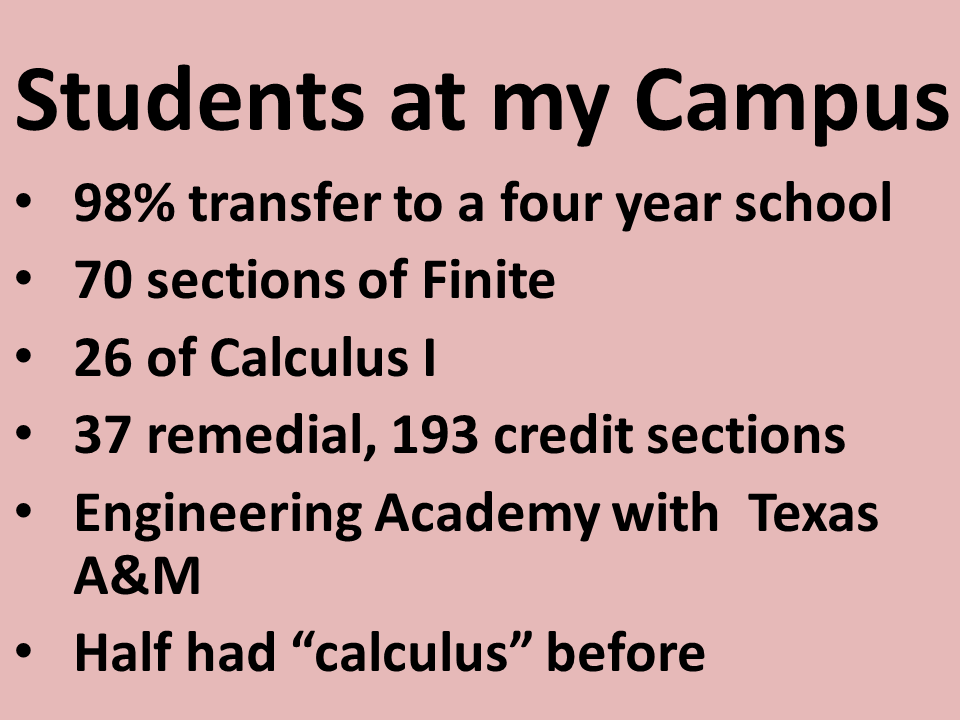
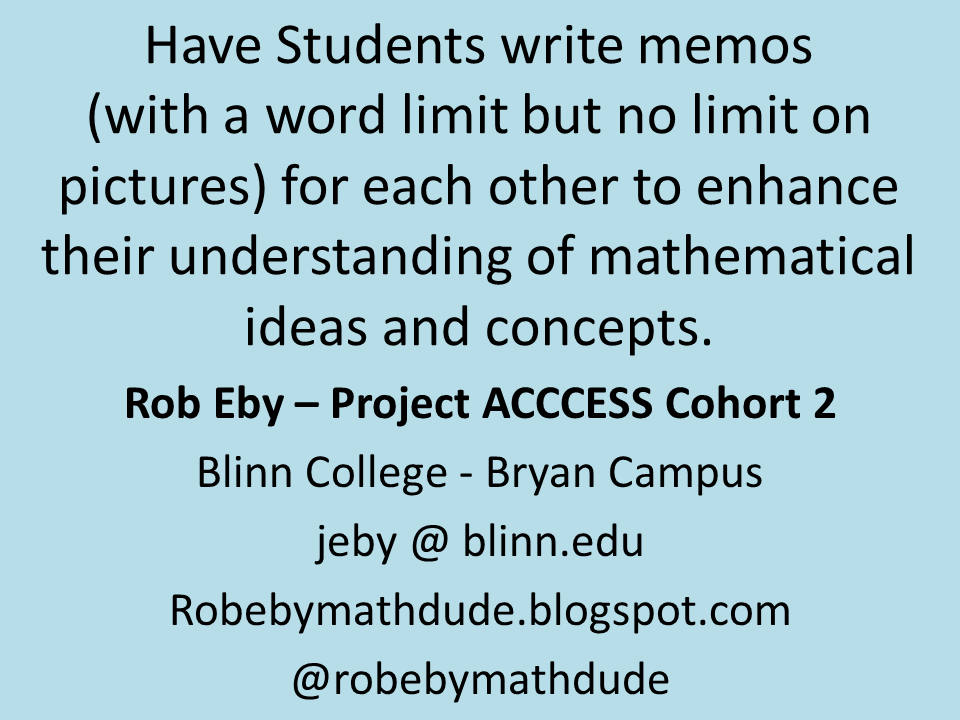
This Thursday afternoon, 1:40 - 1:55 in Room 608, session 1116-A5-1038, I will be presenting on the idea of having students write memos as an assessment. It was something I did this past fall with my Calculus I students.
The basic idea was to have my students form groups and then as a group write a memo under some rules to answer a more conceptual question. The rules were the students could use as many pictures as they wanted, but at most 200 words to answer the question. It was an interesting activity. I learned several things about my students. One of the biggest that I learned was that they really do not understand the density of the real numbers, and what what a continuous function really is. That has changed some things that I will do for the next time I teach Calculus I.
The presentation slides are below, as are the copies of the six different memo question sets that I
used during the semester. I plan on doing memo questions this semester in Calculus II. Hence I plan on doing a few posts this coming spring over how that is going with my two sections.
Memo Question set 1
Memo Question set 2
Memo Question set 3
Memo Question set 4
Memo Question set 5
Memo Question set 6
The slides are here:
NOTICE, Google currently owns blogger, and as such, uses cookies to collect information, potentially a lot of it. You have been warned.
Pages - Fast Find.
Monday, January 4, 2016
Thursday, November 12, 2015
In about a week I will be presenting twice at the AMATYC national conference. The first presentation is an IGNITE talk. Basically 20 powerpoint slides that auto advance every 15 seconds; start talking! I am one of about 22 of us, and I will be talking about using what I call Competency Clusters. Basically the idea is to group your homework problem assignments into small clusters that are related to help students understand the differences and similarities between the problems.
For example, x^2 - 1 = 0 , 1 - x^2 = 0 and x^2 + 1 = 0 all look similar, but only two have solutions over the real numbers.
A copy of the slideshow I used will be posted next week after the conference. I will also post a link to the video of all of the talks when it is up. I would also post copies of the slides, but I have a lot of animation on each slide so it becomes a jumbled mess. A link to the video of the entire show will be posted about 10 days after the conference so you can see all of the talks. Below are the resources I mentioned in the talk. Thanks as always.
Division Clusters
Using Rich Problems for Differentiated Instruction
The Homework Dilemma
The Organisation for Economic Co-operation and Development (OECD) Programme for International Student Assessment (PISA)
For example, x^2 - 1 = 0 , 1 - x^2 = 0 and x^2 + 1 = 0 all look similar, but only two have solutions over the real numbers.
A copy of the slideshow I used will be posted next week after the conference. I will also post a link to the video of all of the talks when it is up. I would also post copies of the slides, but I have a lot of animation on each slide so it becomes a jumbled mess. A link to the video of the entire show will be posted about 10 days after the conference so you can see all of the talks. Below are the resources I mentioned in the talk. Thanks as always.
Division Clusters
Using Rich Problems for Differentiated Instruction
The Homework Dilemma
The Organisation for Economic Co-operation and Development (OECD) Programme for International Student Assessment (PISA)
Friday, January 9, 2015
Statistics simulations with data pulled from a web page!
This is the post that goes with my presentation Sunday at the Joint Mathematics Meetings
The other talk I was doing was over simulations for statistics classes. I discussed the idea of using a data set the students suggested by pulling a data set from a web page and then having the students do various things with the data in the web page.
copies of the slides are here
Handout 1 over the CLT
Handout 2 over CI's
This is the post that goes with my presentation Sunday at the Joint Mathematics Meetings
The other talk I was doing was over simulations for statistics classes. I discussed the idea of using a data set the students suggested by pulling a data set from a web page and then having the students do various things with the data in the web page.
copies of the slides are here
Handout 1 over the CLT
Handout 2 over CI's
Subscribe to:
Posts (Atom)